I encourage you to check out the Common Core's Curriculum Maps in English Language Arts...dodgy business, as some are saying these are not grounded in good literacy research. Not only do teachers have lists of books to teach, now they have maps of what to teach, when. These maps are available for public comment until 9/17...take a look and respond! http://www.commoncore.org/maps/
Common Core’s Curriculum Maps in English Language Arts were written by public school teachers for public school teachers. The maps translate the new Common Core State Standards (CCSS) for Kindergarten through 12th grade into unit maps that teachers can use to plan their year, craft their own more detailed curriculum, and create lesson plans. The maps are flexible and adaptable, yet they address every standard in the CCSS. Any teacher, school, or district that chooses to follow the Common Core maps can be confident that they are adhering to the standards. Even the topics the maps introduce grow out of and expand upon the "exemplar" texts recommended in the CCSS. And because they are free, the maps will save school districts millions in curriculum development costs. The draft maps are available for public comment until September 17. Please tell us what you think!
Friday, August 20, 2010

Saturday, August 14, 2010
Life or Death?
 ...I think about what the nurse said. She's running the show. And suddenly I understand what Gramps was really asking Gran. He had listened to that nurse, too. He got it before I did.
If I stay. If I live. It's up to me.
Hoo-boy! This is an intense read. Reminds me a bit of Crutcher's Deadline and the wonderful Before I Die by Jenny Downham, but unlike the characters in those two books, who don't have a choice whether or not they die--they're both terminally ill--17-year-old Mia in If I Stay, does. She's got a ruptured spleen, broken ribs, a collapsed lung, and she's missing some skin thanks to a horrible car accident that landed her in a coma and killed her parents and younger brother. She has good reason for wanting to die.
To go down as a family. No one left behind.
Reminiscent of the main character Susie in Alice Sebold's The Lovely Bones, Mia narrates the story from some nebulous purgatorial middle world. She's in a suspended state--not dead, not sure if she wants to be alive--and walks around in the hospital, unseen, describing her treatment by doctors and nurses, and grandparents' and friends' (and boyfriend Adam's) reactions to her comatose condition.
What does death feel like? The nicest, warmest, heaviest, never-ending nap?
The narration moves seamlessly back and forth between Mia's real-time observations in the hospital, and the past, where we see Mia and Adam's relationship grow, Mia's burgeoning talent as a cellist (she had applied to Juilliard before accident, but hasn't heard anything back yet), and Mia's loving family. Her parents were hip and wacky, and totally supportive of Mia, even though Mia often felt like she didn't quite "fit in," didn't "belong" because she doesn't consider herself very cool. (She's cooler than she gives herself credit for. As Adam describes her, she's fragile and tough, quiet and kick-ass...one of the punkest girls [he] knows, with a sense of humor so dark you almost miss it. And can I just say for the record, this book has quite possibly the hottest, no-sex-involved make-out scene I've ever read).
But Mia's not sure a world without her parents and younger brother is one she belongs in, either.
Dying is easy. Living is hard.
I won't spoil the ending for you. Go get the book and read it. This is smart, compelling, warm writing--young adult literature at its best.
Tuesday, August 10, 2010
Pop Culture in the Classroom

We all hear the term pop culture, and as teachers many of us try to incorporate it. But what exactly is pop culture? How do we meaningfully incorporate it into our instruction? These are the questions that Hagood, Alvermann, and Heron-Hruby address in Bring It to Class: Unpacking Pop Culture in Literacy Learning (2010, Teachers College Press).
This short book is a wonderful addition to any literacy teacher’s library; it combines theory with practical classroom applications (and also self-checks for educators). One idea I really like is having students complete their own “textual day in the life” charts (pp. 3-7), noting their various identities, (student, teenager, friend, etc.), what values are associated with those identities (education, communication, friendship, etc.), what social networks those identities are a part of (teachers/students, family/friends, friends, etc.), and what literacy learning relates to them (English/math, pop culture, maintaining close bonds).
The authors also define the ways we can view pop culture (mass culture, folk culture, and everyday culture) as well as ways to connect pop culture texts to the curriculum (they also provide many great resources and teaching ideas). I think this is especially relevant to young adult literature.
We won’t see the characters in Great Expectations IMing each other, nor will we read emails from Romeo to Juliet (although having students create these types of messages as part of an assignment might be interesting).
What we do see are novels that incorporate aspects of pop culture like L8r, g8r (Myracle) and Little Brother (Doctorow).
Saturday, August 7, 2010
Behind the Eyes

Hector missed his brother’s wake. He missed the funeral. Dr. Hernández, the intern who treated him in the emergency room, had told him it would be at least a week before he could leave. The ear, the ribs, the spleen, all had to be evaluated. All needed stillness in order to begin to heal.
So begins Francisco X. Stork’s wonderful, and powerful, novel about what it means to really learn to be in control of your life and not let the actions of other negatively influence or direct it. Behind the Eyes is about Hector Robles, a 16-year-old bright, intelligent Chicano living in the projects of El Paso, Texas. We find that Hector is the hope of his family, including his father who died about a year before, his sister, Aurora, and his brother Filiberto, who like the father suffers from a lack of control over his life.
The novel is told in the present with flashbacks and we learn that Filiberto wants the girlfriend of Chava, the leader of the Discípulos, a local gang. A series of events resulting from this “crush” lead to the death of Fili and Hector attacks Chava; Chava is a better fighter and causes serious injuries to Hector. Then the family finds out that there is a contract on Hector’s life. Whether seen as a blessing or curse, Hector is sent to Furman, a reform school in San Antonio.
Hector’s bunkmate is X-lax, who progresses from crass and obnoxious to redeemer; Sansón, seems dumb, and he is “slow” school-wise, but he has the heart of a peacemaker. Forced to take part in the school’s rehabilitation programs or else leave, Hector takes a “mind training” with weights class taught by Díaz, an inmate serving a life sentence without parole at a nearby prison. With the help of X-Lax, Sansón, and Díaz, Hector gets hope back. However, a new student named El Topo arrives and begins to start a psychological warfare with Hector. Thinking that El Topo is there to kill him because of the contract, Hector struggles with fear and whether and how to take action to protect himself.
I won’t give away the ending, but it is very satisfying—and not what readers will expect.
I loved this book and I think that teen readers, especially males, will relate with the struggle to protect, be proactive, take revenge, and all of the other behaviors that only serve to often make things worse. In this novel, it is the “tough” guys who live in peace rather than fight.
The schools here are getting more and more Latino/a students and there are not enough books in the library with Latino/a and Chicano/a characters in them. Behind the Eyes is a book that should be in classrooms and libraries. It resonates with Matt de la Pena's books, but would be an especially good pairing with We Were Here.
Other
Tuesday, August 3, 2010
Once...

"Once upon a time" is how children's stories usually start, and you expect princesses and castles and fairy godmothers. Not so in this compelling, somber story about young Felix in Nazi-occupied Poland. The story opens with Felix, a Jewish boy, day-dreaming about escaping the orphanage where his parents, former bookstore-owners, have placed him to keep him safe while the Nazis go about their exterminating. Felix, being young and full of ideas and an overactive imagination, expects his parents to show up any minute. But they don't, so he must go look for them and tell them about the Nazis. Only when he escapes and sees the atrocities caused at the hands of German soldiers does reality slowly begin to sink in.
Felix--probably because he's grown up reading, and/or being read to, is a gifted storyteller, and it's his stories that keep him and others alive, or at least hopeful. But gradually, Felix must come to terms with the horrible realities surrounding him and reconcile fact and fiction. At one point, when Felix returns to his family's abandoned, ransacked house, he's told: "They're all gone...your parents, all of them." Felix thinks, I want him to stop. I want him to tell me it's just a story.
The Holocaust--and the murder of 1.5 million children--is not "just a story." It's a very real part of our history, one we can never forget. I'm thankful to the author for telling the childrens' stories, and keeping the history alive. This book had me boo-hooing by the end. Add it to your Holocaust YAL collection, and/or use it in a human rights unit to consider the modern-day genocides occuring in Rwanda and the Sudan. Would make a good pair with Boy in the Striped Pajamas and The Book Thief.
Monday, August 2, 2010
Traveling Back in Time

I had high hopes for this book. I mean, just look at the cover. And when you go to Holt's website and click on this title, there's a lovely old-timey, bluegrassy song playing that gets you in the mood.
The story is set in 1800s Missouri, during the time when newly-emigrated Americans are heading west in search of land and luck. Amos Kincaid is the central character, and he's ready for some good luck. His mom, Delilah, dies during childbirth, and his Dad--a trapper--hands him off to his brother for long seasons of time, only to come back and claim him years and years later. The story stretches over many years, and many miles, as Amos's dad, Jake, becomes a scout for a group of families traveling west to Oregon's Wilamette Valley. When Jake returns to Missouri for Amos, it's to bring Amos on the trip west with him.
The traveling west stuff is good and interesting, providing historical and realistic details about the great Western Migration. But the thing is--Amos and his Dad, Jake, are "dowsers," which means they have a magical gift of being able to locate water in the ground. This is a big help to families looking to settle, as many want to be close to water. Jake hates being a dowser, and only uses his gift when he needs to provide for his family. Amos eventually, as an older man, embraces the gift and eventually is able to provide for his family and community.
I really wanted to see Holt do more with this magical element of the story--maybe build up the tension between the son and father's differing views on their gifts, or make it a story, maybe, about the use of natural resources, and the power man has in making decisions about how individuals/communities use life-giving resources.
And what's up with Delilah--Amos's mom?? Before she dies, you get the sense that she's pretty powerful in her own right--there's always birds around when she's in the picture, and a group of mockingbirds attack her abusive dad, Eb, at one point. When she finds out she's pregnant with Amos, she has a dream that he gets passed down from woman to woman, and Amos does, losing a sense of home and family, only to figure out he can redefine those things on his own. What's cool is that each woman who becomes Amos's surrogate mom "sees" Delilah's ghost, as if Delilah is checking in, making sure Amos is properly tended to. She finally disappears when Amos becomes a man, which the reader learns has nothing to do with age but the choices we make. I wanted more Delilah, and I wanted more dowsing, so overall, I left this book feeling like I didn't know what it wanted to be about.
I think if teachers want a good middle-grades historical fiction book about early US settlement and western migration, this is a good one to have around. I think it would make a good pair, too, with We Never Speak of It: Idaho-Wyoming Poems, 1889-1890, a book of poems about Pioneer women and children's experiences during the Western Migration.
Sunday, August 1, 2010
Ever wish someone dead?
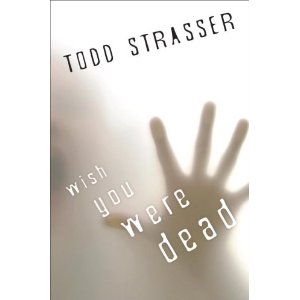
This question that Todd Strasser explores in Wish You Were Dead (2009), a book I devoured in just 90 minutes on the stationary bike at the gym. I literally could not put this book down and until very close to the end (I stayed on the bike in order to finish!), I could not figure out who was responsible for the kidnappings of three high school students.
The book crosses genres: suspense, thriller, and realistic fiction. We learn on thge first page that a high school student is miserable and hates herself because of a popular girl named Lucy (among other classmates). In fact, the mysterious blogger wishes Lucy was dead. Shortly after, Lucy is kidnapped and we get the perspective of the kidnapper who has no mercy for the teen.
Then, there are two more kidnappings--Lucy's ex-boyfriend (Adam) and the classmate he was "cheating" on Lucy with, Courtney.
Alternating between anonymous blog posts with responses, the kidnapper's thoughts, and the actual story, told by Madison, a fried of the missing trio of teens, the book is fast-paced and will keep readers hooked (I was not totally sold on the last page, but I couldn't think of any other way to end the book).
I am a big Strasser fan, ever since I found and used his short story "On the Bridge" (which he still provides free of charge for classroom use here. This book will not disappoint teen readers.
I am now on to Gone by Michael Grant (the first in a series), Terry Pratchett's Nation, and Libba Bray's Rebel Angels . . . all building up for August 24 and Mockingjay!
Subscribe to:
Posts (Atom)